
Do you know how much cash you'll have in the bank 10 weeks from now? Most of the EDs we talk to don't, and that is where good nonprofit cash flow management starts. A 90-day forecast gives you that answer, and you can build one this week.
Why 90 days is the right window for nonprofit cash flow management
A budget tells you what you plan to earn and spend this year. A cash flow forecast tells you when the money actually moves in and out of your account.
Those are two different things. A grant can be fully approved and still not land until March. Payroll goes out every two weeks no matter what.
Ninety days is long enough to see a problem coming and short enough to keep your numbers realistic.
How to build your 90-day cash flow forecast
You don’t need special software. A spreadsheet works fine. Here’s the process we use with clients.
Start with today's cash balance. Use the actual number in your bank accounts, not what your books say you should have.
Set up 13 weekly columns. That covers about 90 days. Weekly beats monthly because payroll and big bills don't wait for month-end.
List your expected cash in. Include grant payments, individual donations, event revenue, and program fees. Only put a grant in the week you expect the money to arrive, not the week it was awarded.
List your expected cash out. Start with the fixed items: payroll, rent, insurance, and loan payments. Then add the variable ones like vendors, supplies, and program costs.
Calculate your ending balance each week. Starting cash, plus cash in, minus cash out. That ending balance becomes next week's starting cash.
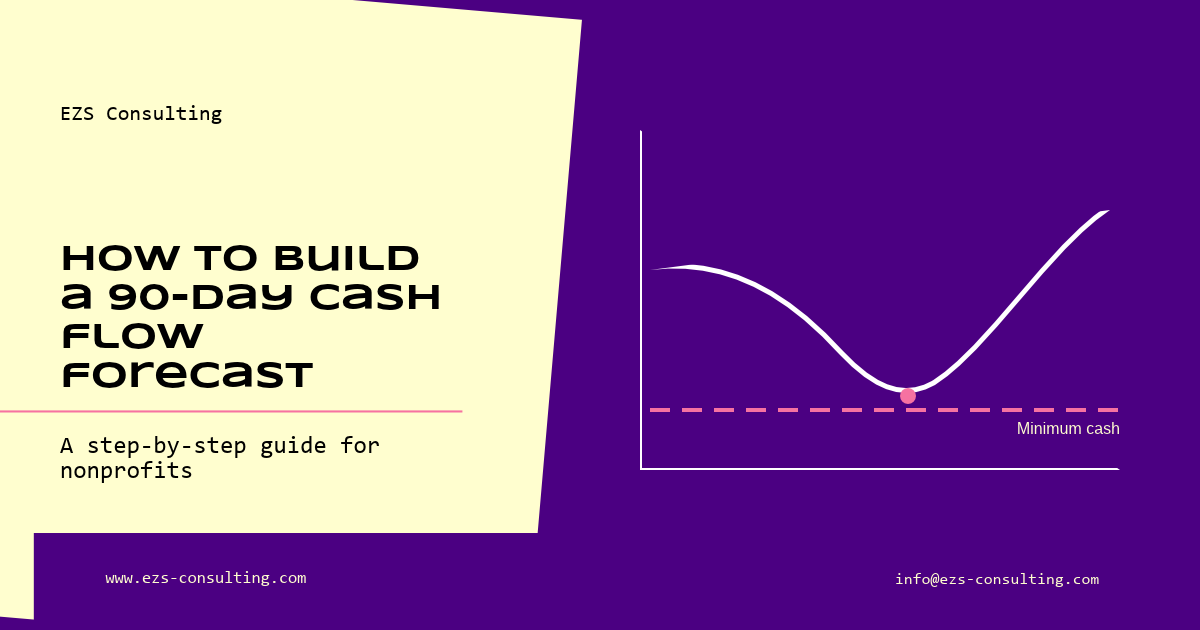
Set a minimum cash line. Pick a floor you never want to drop below. Many organizations use one month of operating expenses or two payroll cycles. Any week below that line gets flagged.
Update it every week. Replace your estimates with actuals, then add a new week at the end. It takes about 30 minutes once it's set up.
If no one on your team has time to keep this updated, a fractional CFO can build and run it for you.
What to do when you spot a gap
The whole point of the forecast is to see trouble early. When a week dips below your minimum, you have options, and you have time to use them.
Follow up on receivables. Call funders about payments that are late or ask whether a reimbursement can be sped up.
Shift timing on expenses. Some purchases can wait a few weeks without hurting programs.
Talk to your board early. A heads-up two months out is a planning conversation. A heads-up two days out is a crisis.
Line up a backstop. If you have a line of credit or reserve fund, decide now when you would use it.
Common mistakes to avoid
We see the same few problems over and over.
Counting restricted funds as available cash. If the money can only be used for one program, don't use it to cover general rent.
Being too hopeful about timing. If a funder usually pays 30 days late, plan for 30 days late.
Forgetting the lumpy expenses. Annual insurance, audit fees, and software renewals sneak up on you.
Building it once and filing it away. A forecast that sits untouched for two months is just a guess.
The bottom line on nonprofit cash flow management
Good cash management doesn't mean having more money. It means knowing ahead of time when money will be tight, so you can act before it becomes urgent.
If you'd like help setting up your first forecast, or want a second set of eyes on the one you have, we're happy to walk through it with you.
Prefer email? Reach us at info@ezs-consulting.com or learn more at www.ezs-consulting.com.
Ethan Scott
Founder, EZS Consulting · Fractional CFO & Operations Lead
